Thursday, April 20, 2017

HW for E (for Monday) and A (Tuesday)

Hiya.

Perform some calculations related to your lab.  Behold - the thin lens equation (also known as the lens/mirror equation):

Use this equation to solve for f for each case where you have do and di data.  You have a theoretical f (10 or 20 cm, given by the manufacturer of the lens or mirror you used).  You are going to determine an experimental version - essentially, comparing your work to their claim.

It is probably easiest to solve the above equation algebraically first - solving for f.  To wit:

f = (do di) /  (do + di)

Determine the experimental values of f for all of your trials.  All lab group members should do this before the next class.

Next, determine percent errors of your value from the claimed f:

% error = [ (exp f - theo f) / (theo f) ] * 100

The easiest path for all of this is to use a spreadsheet to do the calculations.


Tuesday, April 18, 2017

HW for Thursday (E) and Friday (A)

Please look up the following and be able to distinguish between the two:

Real image
Virtual image

Also, read the lab handout, please.  A block - you'll get the lab handout Wednesday before the quiz.

Thanks everyone!


Monday, April 17, 2017

Quiz practice

Consider a 650 nm laser beam.  It heads into a block of plastic (n = 1.7) at an initial angle of 40 degrees.  Find the following:

a.  angle of refraction
b.  frequency inside the block
c.  wavelength inside the block
d.  critical angle of the block
e.  speed of light inside the block

Be sure to review how to draw "normal lines" (perpendicular) and predict the path that light takes upon entering a new medium.

Monday, April 3, 2017

E and A block homework

Please come to class with definitions of:

- Index of refraction
- Snell's law - with an equation, if possible, with a diagram and/or variables explained

Wednesday, March 29, 2017

E block homework for Friday


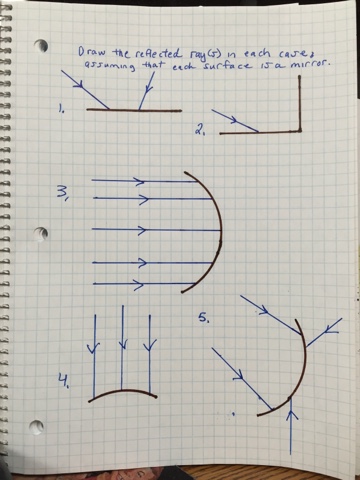
Also, write an accurate statement that describes the law of reflection.  It should stand on its own without pictures, and should be your own description (not swiped from the Internet).

Light 3 - Refraction

Refraction:


Consider a wave hitting a new medium - one in which is travels more slowly. This would be like light going from air into water. The light has a certain frequency (which is unchangeable, since its set by whatever atomic process causes it to be emitted). The wavelength has a certain amount set by the equation, c = f l, where l is the wavelength (Greek symbol, lambda).
When the wave enters the new medium it is slowed - the speed becomes lower, but the frequency is fixed. Therefore, the wavelength becomes smaller (in a more dense medium).
Note also that the wave becomes "bent." Look at the image above: in order for the wave front to stay together, part of the wave front is slowed before the remaining part of it hits the surface. This necessarily results in a bend.

MORE DETAIL:


The general rule - if a wave is going from a lower density medium to one of higher density, the wave is refracted TOWARD the normal (perpendicular to surface) line. See picture above.


Refraction is much different than reflection. In refraction, light enters a NEW medium. In the new medium, the speed changes. We define the extent to which this new medium changes the speed by a simple ratio, the index of refraction:
n = c/v
In this equation, n is the index of refraction (a number always 1 or greater), c is the speed of light (in a vacuum) and v is the speed of light in the new medium.
The index of refraction for some familiar substances:
vacuum, defined as 1
air, approximately 1
water, 1.33
glass, 1.5
polycarbonate ("high index" lenses), 1.67
diamond, 2.2
The index of refraction is a way of expressing how optically dense a medium is. The actual index of refraction (other than in a vacuum) depends on the incoming wavelength. Different wavelengths have slightly different speeds in (non-vacuum) mediums. For example, red slows down by a certain amount, but violet slows down by a slightly lower amount - meaning that red light goes through a material (glass, for example) a bit faster than violet light. Red light exits first.
In addition, different wavelengths of light are "bent" by slightly different amounts. This is trickier to see, but it causes rainbows and prismatic effects.

Some animation, etc.:

http://faraday.physics.utoronto.ca/PVB/Harrison/Flash/Waves/Refraction/Refraction.html

http://www.animations.physics.unsw.edu.au/jw/light/Snells_law_and_refraction.htm

http://www.freezeray.com/flashFiles/Refraction2.htm

https://phet.colorado.edu/en/simulation/bending-light


And all of this helps explain how lenses form images.